🚀 The Power of SPIN Selling: Uncovering Customer Needs
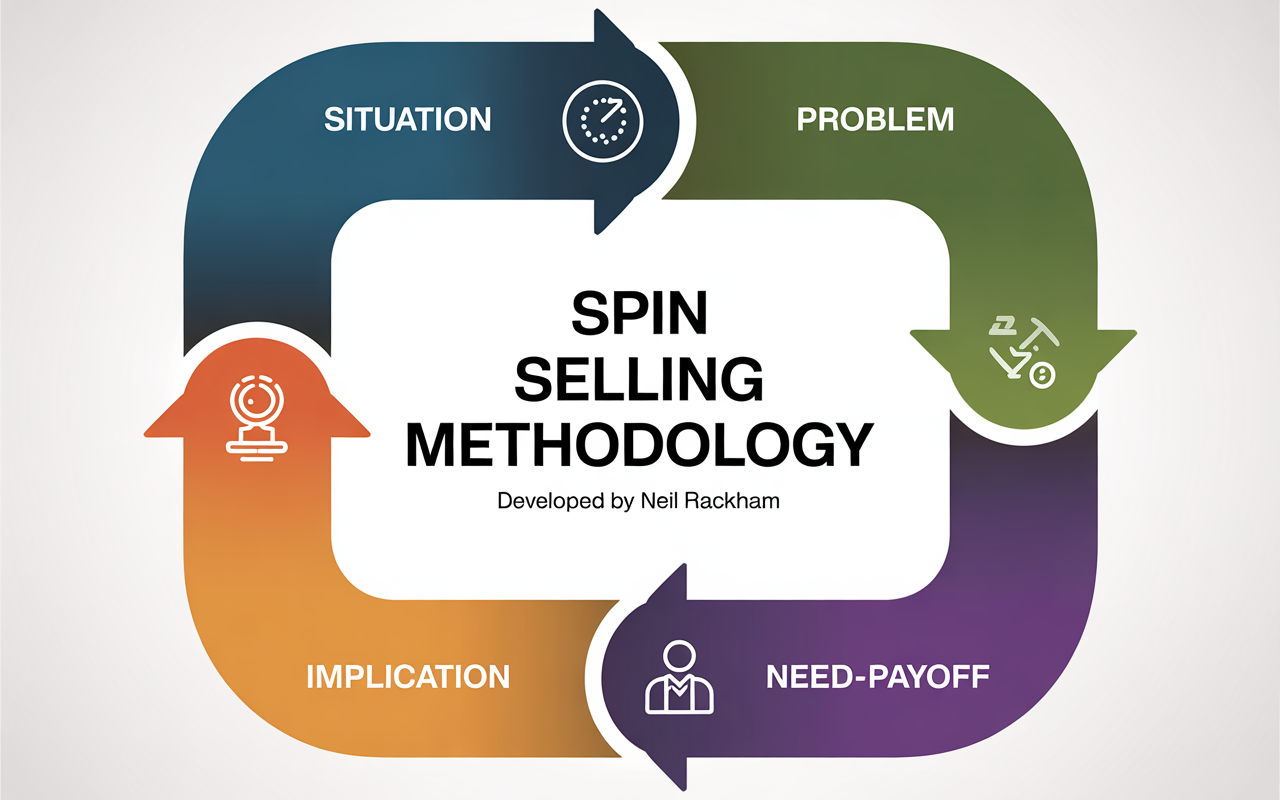
The SPIN Selling methodology, developed by Neil Rackham after extensive research into successful large-scale sales, provides a powerful, consultative approach to uncover and develop customer needs.
It shifts the focus from aggressively pitching a product to guiding the customer through a logical discovery process, ultimately allowing them to realize the value of the seller’s solution for themselves.
The core of this methodology is an acronym that outlines a sequence of four types of questions: Situation, Problem, Implication, and Need-payoff.





When used effectively, these questions progressively build the customer’s recognition of their problem and the positive impact of a solution, leading to what Rackham termed Explicit Needs—a clear, articulated want or desire for a specific solution.
1. Situation Questions: Establishing Context 🗺️
Purpose: To gather facts and background information about the customer’s current situation, including their processes, tools, responsibilities, and challenges.
How They Uncover Needs: Situation questions are essential for establishing a baseline understanding.
Before a salesperson can identify a problem, they must know the environment in which the problem exists.
They help the salesperson qualify the prospect and tailor subsequent questions.
However, successful salespeople use these questions sparingly, as too many can bore or annoy the customer with information the seller should have researched beforehand.
Key Characteristics:
- Focus on facts and data.
- Should be used to build rapport and contextual knowledge.
- Best to research basic facts before the call to limit these questions.
Example Questions:
- “What systems are you currently using to manage your inventory?”
- “Can you describe your team’s current process for handling customer support tickets?”
- “How long have you been using your current service provider?”
2. Problem Questions: Identifying Pain Points 🎯
Purpose: To probe for specific difficulties, dissatisfactions, or problems the customer is experiencing that the seller’s product or service can solve.
How They Uncover Needs: These questions transition the conversation from neutral facts to the customer’s challenges.
They help the customer articulate their Implied Needs—general statements of a problem or pain point (e.g., “The system is slow” or “We have too many errors”).
The answers reveal the areas of dissatisfaction that a solution should address.
Key Characteristics:
- Focus on challenges, difficulties, or inefficiencies.
- Encourage the customer to verbalize their dissatisfaction.
- Directly relate to the problems your offering is designed to fix.
Example Questions:
- “Are you happy with the speed of your current reporting process?”
- “What difficulties have you encountered with your existing equipment’s reliability?”
- “Do you ever feel that your team wastes time on manual data entry?”
3. Implication Questions: Developing the Cost of Inaction 🚨
Purpose: To explore the effects, consequences, and implications of the customer’s problems (implied needs).
These questions develop the severity of the problem and create a sense of urgency.
How They Uncover Needs: This is often the most powerful stage in large sales.
Implication questions turn a minor irritation into a serious, business-critical issue by linking the problem to other consequences, such as financial loss, increased workload, decreased customer satisfaction, or lost competitive advantage.
By quantifying or dramatizing the impact, the seller raises the value of solving the problem in the customer’s mind.
Key Characteristics:
- Focus on the consequences and negative impact of the problem.
- Help the customer see the cost of not solving the issue.
- Create urgency and make the problem seem larger and more serious.
Example Questions:
- “How does the slow reporting process affect your ability to make timely strategic decisions?” (Connecting slow process to strategic impact)
- “What is the annual cost to your department in lost productivity due to those equipment failures?” (Quantifying the financial impact)
- “If manual data entry errors continue, how will that impact your customer satisfaction scores and brand reputation this quarter?” (Connecting errors to customer/brand impact)
4. Need-Payoff Questions: Highlighting the Solution’s Value ✨
Purpose: To encourage the customer to focus on the benefits and value of solving the problem, rather than the problem itself.
These questions guide the customer to state the benefits of the proposed solution themselves.
How They Uncover Needs: After the Problem and Implication questions have amplified the severity of the challenge, Need-Payoff questions shift the focus to a positive, future-focused outlook.
They lead the customer to articulate their Explicit Needs—the clear desire for the solution’s benefits (e.g., “I need a fast, reliable system to improve decision-making”).
By having the customer state the benefit, it increases their acceptance and commitment to the solution, making it easier for them to “sell” the idea internally to other decision-makers.
Key Characteristics:
- Focus on the positive impact of the solution.
- Ask about the usefulness, value, or importance of solving the problem.
- The answer should essentially be the benefit of the seller’s solution.
Example Questions:
- “If you had a reporting system that could provide instant, accurate data, how would that improve your strategic decision-making?”
- “How valuable would it be if you could eliminate the monthly equipment failures and the associated loss of productivity?”
- “If you could fully automate data entry, what kind of time savings would that create for your team each week?”
Summary of the SPIN Strategy
The SPIN methodology is about progressive commitment. The questions are structured to move the customer through a logical and psychological sequence:
By meticulously following this sequence, a salesperson can transform a simple “implied need” (a recognized problem) into an “explicit need” (a desire for a specific solution that addresses the high-impact consequences).
This method makes the sales process customer-centric, consultative, and highly effective for complex, high-value transactions.
💼 SPIN Selling in Action: The IT Security Upgrade
Imagine you are a salesperson for a company that offers AI-powered cybersecurity software that automates threat detection and response.
Your potential client is the IT Director of a mid-sized financial services firm.
1. Situation Questions (S) 🗺️
Goal: Establish the baseline facts about their current security infrastructure and processes. (Used sparingly, assuming some pre-call research.)
| Question | Focus | Expected Answer |
| “What security systems do you currently have in place for endpoint detection and response (EDR)?” | Current tools/systems. | “We use a legacy EDR system, mostly on-premise.” |
| “Can you walk me through your process for investigating a potential threat once an alert is triggered?” | Current process/workflow. | “A Level 1 analyst manually reviews the logs, escalates to Level 2 if it’s confirmed, and then we isolate the endpoint.” |
2. Problem Questions (P) 🎯
Goal: Identify specific difficulties or dissatisfactions with their current setup (the Implied Needs).
| Question | Focus | Expected Answer (Implied Need) |
| “How often does your Level 1 team get overwhelmed by false positive alerts from the current system?” | Inefficiency/Volume. | “It’s a daily issue. We spend about 4-5 hours a day on noise.” |
| “Do you feel your current system provides adequate real-time visibility into emerging, zero-day threats?” | System performance/Gaps. | “Not entirely. We rely heavily on manual updates and threat intelligence feeds, which can be slow.” |
3. Implication Questions (I) 🚨
Goal: Turn the minor inconveniences (false positives, slow process) into a serious business problem by exploring the consequences.
| Question | Focus | Expected Consequence/Impact |
| “When your Level 1 analysts are spending 5 hours a day chasing false positives, how does that impact their ability to focus on high-priority, actual threats?” | Opportunity Cost/Risk. | “We’re worried we’ll miss a real attack. We’ve had a couple of near-misses where real threats were buried in the noise.” |
| “Since it takes time for a manual investigation and isolation, what is the average time between an initial alert and actual containment of a sophisticated threat?” | Financial/Security Risk. | “It can take several hours. In a regulated industry like finance, that kind of exposure time could result in significant regulatory fines and client data loss.” |
| “How does this delay and the risk of a breach affect your relationship with key stakeholders or the board?” | Business/Reputation Risk. | “The board is constantly asking about our cyber risk exposure. It’s creating a lot of stress and scrutiny on my department.” |
4. Need-Payoff Questions (N) ✨
Goal: Encourage the customer to articulate the value of the solution (AI automation) that resolves the high-impact problems (the Explicit Need).
| Question | Focus | Expected Answer (Explicit Need) |
| “If a new system could automatically triage 95% of those false positives and instantly quarantine an infected endpoint, how would that impact the Level 1 team’s efficiency?” | Solution Benefit (Efficiency). | “That would be huge. My team could finally focus on proactive defense, not just firefighting. We need that level of automation.” |
| “Assuming that automation cuts your threat containment time from hours down to minutes, how would that reduce your overall financial and regulatory risk exposure?” | Solution Value (Risk Mitigation). | “It would give us the confidence to report to the board that we have an immediate and effective defense. The reduced risk alone would justify the investment.” |
| “If your security posture were dramatically improved, what new business initiatives could your team start to focus on?” | Strategic Value. | “We could finally roll out our new cloud migration project, which has been stalled due to security concerns. A system that enables that is exactly what we’re looking for.” |
By the time you finish the Need-Payoff questions, the IT Director has defined their problem, quantified the severe consequences, and, most importantly, articulated the specific benefits and value of your AI-powered automation solution in their own words—making the eventual pitch and closing process much easier.