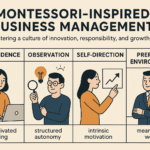
The “Prepared Environment”: Translating Montessori Principles to Business productivity
In the world of early childhood education, the Montessori method is revered for its concept of the “Prepared Environment.”
In these classrooms, nothing is accidental.
Every object has a place, every tool is accessible, and the layout is meticulously designed to foster autonomy, deep focus, and intrinsic motivation.





Why should this matter to business leaders?
Because the cognitive needs of a high-performing employee are strikingly similar to those of a learning child.
Both require an environment that removes friction, encourages exploration, and supports sustained concentration.
When we view the office (physical or digital) not merely as a container for people, but as an active tool for success, we unlock new levels of productivity.
1. Minimizing Distractions: The Architecture of Focus
In a Montessori classroom, visual noise is kept to a minimum to allow for “Deep Work.”
In the modern business world, the open-office plan has often achieved the opposite, creating a barrage of auditory and visual interruptions.
To minimize distractions, the environment must offer:
Zoning based on Activity: Just as a classroom has a “quiet reading corner” and a “sensory table,” offices need distinct zones. High-traffic collaboration areas must be acoustically separated from “library zones” designated for deep focus.
Visual Calm: Clutter taxes the brain’s processing power. A minimalist aesthetic with purposeful storage solutions reduces cognitive load, allowing employees to direct their mental energy toward complex problem-solving rather than filtering out visual chaos.
Acoustic Control: Utilizing sound-masking technology and soft furnishings (carpets, acoustic panels) to dampen voice carry, preventing the “library effect” where every whisper is audible.
2. Encouraging Creativity: Designing for Inspiration
Creativity rarely flourishes in sterile, fluorescent-lit boxes. To spark innovation, the environment must stimulate the brain without overwhelming it.
The Biophilia Hypothesis: Humans possess an innate tendency to seek connections with nature. Integrating this into the workspace is proven to boost cognitive function.
Key Elements for Creativity:
Natural Light: Exposure to daylight regulates circadian rhythms, keeping energy levels consistent and warding off the mid-afternoon slump.
Flexible Furniture: Creativity requires movement. Standing desks, movable whiteboards, and casual seating areas allow employees to physically shift their perspective, which often leads to a mental shift in perspective.
Biophilic Design: Incorporating living walls, indoor plants, and natural materials (wood, stone) reduces stress and improves cognitive performance by up to 15%.
3. Enhancing Collaboration: Frictionless Interaction
Collaboration shouldn’t require a scheduled meeting; it should happen organically. A well-prepared environment removes the barriers to communication.
Collision Zones: Strategic placement of communal resources (coffee machines, printers, water coolers) in central locations encourages “unplanned collisions” between departments, often leading to cross-functional innovation.
The “Campfire” Layout: Circular seating arrangements or round tables invoke a sense of equality and encourage participation from all members, unlike rectangular tables which subconsciously reinforce hierarchy.
Visible Thinking Tools: Floor-to-ceiling whiteboards or glass walls allow ideas to be displayed, iterated upon, and shared asynchronously by anyone walking by.
4. Promoting Psychological Well-being: The Human-Centric Approach
Productivity is unsustainable without well-being. If the environment causes physical discomfort or low-grade anxiety, performance plummets.
The pillars of environmental well-being:
Ergonomics: Investing in high-quality, adjustable chairs and monitors is not a luxury; it is a preventative measure against fatigue and long-term injury.
Agency and Control: Giving employees control over their environment (dimmable lighting, temperature control, or the choice of where to sit) significantly increases job satisfaction and reduces burnout.
Psychological Safety in Design: Glass walls represent transparency, but there must also be private spaces where employees can decompress or take a personal call without feeling “watched.”
5. The Digital Prepared Environment
In the modern hybrid era, the “workspace” is also a screen. The principles of the Montessori prepared environment must apply to our digital infrastructure.
| Physical Principle | Digital Equivalent |
| Everything has a place | Intuitive File Structures: A standardized, logical folder hierarchy so employees don’t waste time hunting for documents. |
| Accessible Tools | Single Sign-On (SSO): Reducing friction by having all software tools accessible through one portal. |
| Minimize Noise | Notification Hygiene: Establishing company norms that discourage “Reply All” and allow for “Do Not Disturb” status on chat apps. |
| Clean Aesthetics | User-Friendly UX: Internal dashboards and intranets that are visually clean and easy to navigate. |
Summary
A haphazard environment produces haphazard results.
By treating the workspace as a strategic asset—meticulously preparing it to support the specific behaviors you want to see—you transition from managing people to enabling performance.
The Role of the Environment in productivity
In Montessori education, the prepared environment is not an afterthought—it is the teaching strategy.
Classrooms are intentionally designed to promote focus, independence, and a sense of calm efficiency.
Everything has a purpose, a place, and a clear reason for being there. When the environment supports the learner, productivity and mastery naturally follow.
The same principle applies to business.
A well-prepared business environment—whether it’s a physical office or a digital workflow—acts as an invisible manager.
It guides behavior, supports better decision-making, and reduces the friction that drains energy and time.
When leaders intentionally design their environments, employees can spend more time doing meaningful work and less time fighting against clutter, confusion, or inefficiency.
Why Environment Matters in Business
Just as Montessori classrooms remove unnecessary barriers to support concentration and autonomy, workplaces can be shaped to do the same.
Employees thrive when the environment:
Reduces cognitive load
Makes expectations clear
Reinforces workflow habits
Supports both independence and collaboration
Communicates respect and professionalism
Environment is culture you can see, touch, and feel. It’s the physical and digital expression of your values.
How Thoughtfully Designed Workspaces Improve productivity
1. Minimize Distractions
Visual clutter, noise, unclear workflows, and digital overwhelm all chip away at focus. In Montessori classrooms, simplicity and clarity are core.
The same principles help employees stay present and productive:
Organized workstations
Clear signage or labels
Streamlined digital dashboards
Reduced interruptions through spatial or policy design
Predictable schedules and routines
The goal is not sterility—it’s intentionality.
2. Encourage Creativity
Creativity blooms in environments that feel safe, flexible, and inspiring.
Montessori rooms use open shelves, beautiful materials, and freedom of movement to signal possibility. In a workplace, creativity grows when:
Spaces are visually calm but stimulating
Tools and materials are accessible
Brainstorming areas invite exploration
Digital platforms reduce barriers to experimentation
Employees feel autonomy over how they work
People generate better ideas when their environment supports curiosity rather than shutting it down.
3. Enhance Collaboration
Montessori classrooms are structured to make collaboration natural and seamless. In business, the environment should do the same:
Clear shared spaces
Configurable seating arrangements
Digital tools that support real-time communication
Meeting rhythms that respect people’s time
A culture that values teamwork over hierarchy
When the environment encourages connection, collaboration becomes effortless rather than forced.
4. Promote Psychological Well-Being
A peaceful, orderly environment reduces stress. Montessori educators know that calm surroundings support emotional regulation—for children and adults.
In business contexts, well-designed spaces:
Reduce anxiety and overwhelm
Signal respect and professionalism
Support physical comfort (lighting, ergonomics, air quality)
Create a sense of safety and predictability
Allow employees to do their best work without unnecessary strain
Psychological well-being is not a “perk”; it’s a productivity strategy.
Final Thought
Montessori reminds us that environment shapes behavior.
When leaders thoughtfully prepare the physical and digital landscapes their teams work within, productivity stops being something you must force—and becomes something people naturally experience.
A well-prepared environment empowers people to contribute at their highest level, with clarity, confidence, and creativity.
Go to Montessori Business Main